The burning cross
Native SonThe burning cross is a racial threat that overturns the religious meaning Bigger Thomas has recently been offered. When he sees it above the crowd during his removal under police guard, he recognizes it as a sign of the Ku Klux Klan, not an invitation to Christian faith. Its appearance makes the cross Reverend Hammond has placed around his neck feel newly dangerous, and Bigger ultimately throws that cross away. The scene binds public racial terror to a private rupture with religious hope.
Appearance and Immediate Context
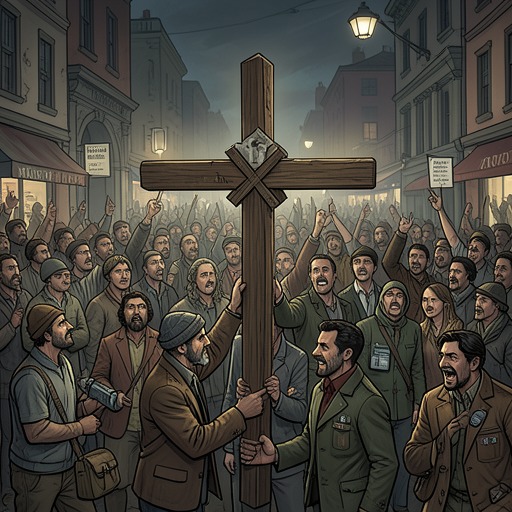
As Bigger is being led through a hostile crowd, a building across the street comes into view above the onlookers, with a cross burning on its roof. People shout threats, and someone tries to rush him before police hold the person back. Bigger looks toward the roof and connects the spectacle to himself, though he initially cannot understand why a cross would be burned. The threat is directed at him in the scene’s immediate setting: the crowd is shouting for his death as he is taken away.
The cross appears not in isolation but amid the faces, voices, and police escort surrounding Bigger. He is placed in a car between two policemen, still watching the fire as the vehicles travel along State Street and then west on Twenty-sixth Street. The procession carries him from the public threat to a cell; the sign remains in his thoughts as the crowd falls behind. The episode therefore makes the cross part of his passage into confinement, rather than a detached emblem whose meaning can be considered apart from the danger around him.
Two Crosses, Two Meanings
The sight recalls Reverend Hammond’s visit that morning and his account of Jesus, the cross, and a life shaped by love. For Bigger, that Christian cross had suggested humility, wonder, and the possibility of hope. The burning one means the opposite. He understands that its association is with the Ku Klux Klan and hatred toward him, not with the preacher’s promise of salvation. The distinction is made through the contrast between the two signs: one had led him toward reverence; the other makes him want to curse and retaliate.
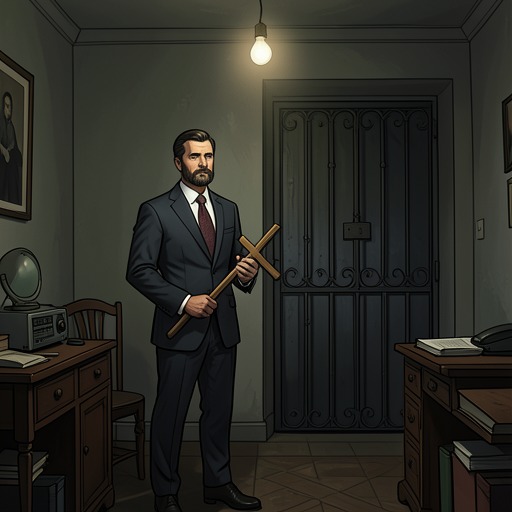
Reverend Hammond’s cross is physically present against Bigger’s chest while the roof-top cross occupies his view. That juxtaposition turns an abstract conflict of meanings into a conflict between objects: both have the same shape, but the violence of the public spectacle transforms how the object he wears feels to him. Bigger experiences the preacher’s gift not as protection from the threat but as something exposed to it. The cross that had seemed to offer hope now seems liable to become another source of danger, and Bigger feels betrayed by having allowed himself to hope.
Rejection in the Cell
After he is taken into a cell, Bigger tears open his shirt, removes the cross from his neck, and throws it away. The men present react with amazement and urge him not to discard what they regard as his cross. Bigger answers that he can die without one; when told that only God can help him, he rejects the premise that he has a soul to save. The exchange makes his act more than a refusal of an object: it is an explicit refusal, at that moment, of the religious assurance others offer him.
The rejection recurs after the preacher returns. Reverend Hammond gathers his belongings and the cross, then leaves the cross inside the cell. Once alone, Bigger picks it up, holds it briefly, and flings it through the bars. The second gesture matters because the object has been returned to him rather than simply left where it fell. He rejects it again, and the sound of it striking the wall marks his effort to keep distance from the hope he now associates with exposure and disappointment.
Aftermath and Significance
The burning cross does not settle into a single meaning for Bigger. It remains tied to the Ku Klux Klan and to the hatred signaled by the crowd, while the preacher’s cross remains associated with a form of Christian salvation that Bigger can no longer accept. The scene’s force lies in the collision of these meanings: a religious symbol is used as an instrument of racial intimidation, and the threat compromises the comfort that the same symbol had briefly offered him.
After his emotional storm passes, Bigger notices that Black and white prisoners are segregated into different cell blocks even inside Cook County Jail. The observation broadens the scene beyond the burning spectacle: racial division persists within the institution that has taken him into custody. He resolves not to trust anyone or anything, including Jan and Max, and to rely only on what comes from himself. His rejection of the cross thus leads into a wider withdrawal from other people and from hope. The image’s consequence is not reconciliation or consolation, but Bigger’s determination to face what comes without the promise of a cross that might, in his eyes, turn to fire.